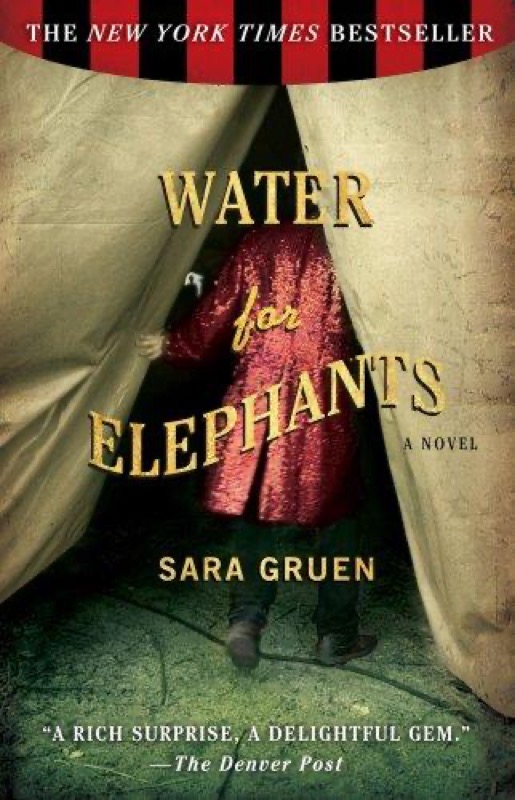
Water for Elephants
A ninety-year-old in a nursing home remembers the year he ran away with a Depression-era circus — the animals, the cruelty, and the elephant who understood Polish.
Hook & thesis
Water for Elephants is framed by erasure: old Jacob Jankowski — ninety-three, or ninety; he can’t be sure, which is the point — sits in a nursing home where the staff manage his days and nobody believes his stories, while a circus sets up across the street. The memory is 1931: young Jacob, orphaned mid-degree and penniless, hops a freight train into the Benzini Brothers circus, a failing, brutal operation where surplus workers are ‘redlighted’ — thrown from the moving train — and where August, the charismatic animal trainer, beats the elephant Rosie for failing commands she was never given in a language she understands. Rosie is the book’s moral center, and the discovery that she answers to Polish is the novel in miniature: most of its cruelty is somebody not bothering to learn how another creature speaks. Verdict: A storyteller’s novel, researched to the sawdust and built on old-fashioned virtues — scene, stakes, a villain you genuinely fear. Its cost is the frame’s sentimentality, and an ending that runs away with the circus one time too many: charming and slightly rigged at once.
The contextual pivot
Water for Elephants was Gruen’s third novel, published in 2006 after she left a technical-writing career to write fiction, and it was researched like a brief: circus histories, the archives at Circus World in Baraboo and the Ringling collections in Sarasota, interviews with old-timers, period photographs studied until she could smell the sawdust. Many chapters are seeded from real circus incidents and lore. It broke out as the decade’s great word-of-mouth historical novel — book clubs, years on the bestseller lists, a 2011 film — and its lineage is the storyteller’s tradition rather than the modernist one: Steinbeck’s Depression, Dickens’s traveling shows, the framed confession of an old man who has kept one secret for sixty years. Its arrival also marked a revival — big-top historical fiction as a going concern, and Rosie the elephant as the rare animal character in adult fiction treated as a person with a language rather than a symbol with legs.
Deep-dive critique
The narration is first person throughout, Jacob’s, across two timelines — the young veterinary student of 1931 and the nonagenarian in the nursing home — and the frame is load-bearing rather than decorative: old Jacob’s present-tense chapters, with their managed meals, disbelieving nurses, and a mind misplacing its own age, establish what the circus chapters are for. Memory here is not nostalgia; it’s the last property a person owns outright, and the home is taking it in installments. Gruen’s prose is researched to the level of texture — feed bills, train logistics, the economics of a failing show — and the circus is rendered as a workplace before it is a romance, which is the book’s discipline: spectacle is what the customers see; the novel stays backstage with the labor and the animals. August is the craft risk — a charming, cultivated abuser given a period-plausible diagnosis that the book deploys carefully, explanation without absolution — though Marlena, seen through young Jacob’s wanting, remains thinner than the men and animals around her: the performer’s interiority is the one tent Gruen doesn’t enter. The ending’s double movement — the secret kept sixty years, then the old man running away with the circus one last time — is either the frame’s perfect rhyme or its sentimentality winning; the book has earned enough goodwill by then that most readers sign. Rosie, meanwhile, is the standard: an animal written as a mind, whose ‘stubbornness’ was a language barrier — the novel’s whole ethics in one elephant.
Discussion launchpad
An elephant written off as stupid because nobody spoke her language. The book keeps restaging that mistake at every scale.
Questions for the room:
- Where else is cruelty here just a failure to learn how another creature — or person — speaks?
- Old Jacob can’t fix his own age, and the home treats his past as a symptom. What does the frame claim about who owns a life story at the end of it?
- Jacob keeps the secret of August’s death for sixty years. Loyalty, love — or the last piece of the circus he refuses to surrender?
- August is charming, cultivated, and a monster, and the book gives him a period diagnosis. Does it explain him, excuse him, or date the novel’s psychology?
- The ending sends Jacob off with the circus one more time. Earned magic — or the novel refusing its own frame’s realism at the last moment?