
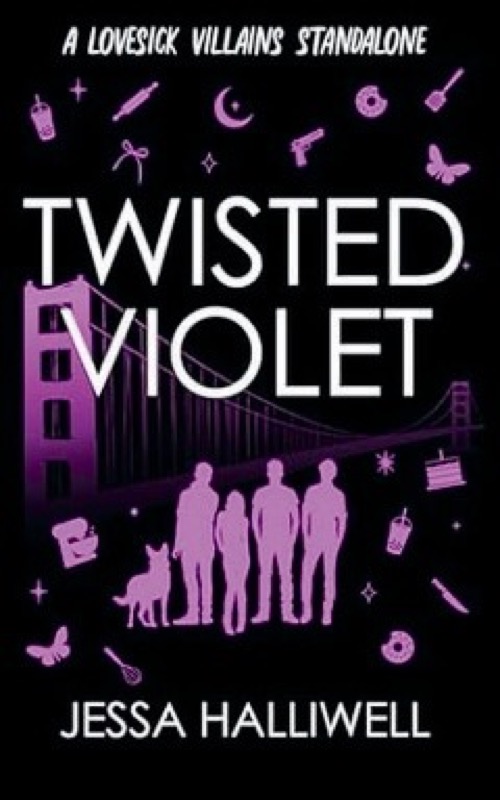
Twisted Violet
A Lovesick Villains Standalone
Hook & thesis
In Jessa Halliwell’s Twisted Violet, the author intricately weaves a tale of obsession and desire, exploring the dark underbelly of love through the lens of villainous characters. Verdict: This book is a tantalizing exploration of how love can be both a sanctuary and a prison, driven by the complexity of desire that transcends conventional romance.
The contextual pivot
Positioned firmly within the reverse-harem subgenre, Twisted Violet diverges from typical narratives by embracing its dark romance elements with a gothic flair. Halliwell’s work invites readers who are familiar with the genre’s tropes but challenges them to confront the moral ambiguity of its characters. Unlike lighter takes on romance, Halliwell’s narrative caters to an audience that revels in the thrill of dangerous love, bridging niche themes to captivate a broader readership that appreciates psychological depth and moral complexity. This standalone novel operates in a landscape filled with lovesick villains, reminiscent of works by authors like Sarah J. Maas and Kerri Maniscalco, yet it carves its own path through a more visceral exploration of wish fulfillment intertwined with peril.
Deep-dive critique
Halliwell’s prose is deliberately crafted to evoke a sense of urgency and tension, expertly using pacing to reflect the characters’ spiraling desires. The narrative unfolds through a close third-person point of view that allows the reader to intimately experience the protagonist’s turmoil, drawing them into a world where the line between love and obsession blurs. The structure, employing a non-linear timeline, enhances the suspense and mirrors the chaotic emotional landscape of the characters, often leaving the reader questioning the reliability of their perceptions.
Character development shines particularly in the portrayal of the central figure, whose relationships with her suitors reveal layers of vulnerability and strength. Halliwell’s dialogue is sharp and charged, effectively communicating the underlying tension between characters, while the world-building immerses readers in a vividly rendered San Francisco, where the backdrop serves as a character in itself, steeped in shadow and intrigue. However, the book occasionally falters when it leans too heavily on certain tropes, such as the glorification of unhealthy relationships, which may alienate some readers who seek redemption arcs or growth beyond mere desire.
The ending, while climactic, raises questions about the extent to which the characters have truly evolved. Are they imprisoned by their desires, or have they forged a new path? This thematic ambiguity resonates throughout the narrative, compelling an exploration of the nature of love and the cost of obsession.
Discussion launchpad
Twisted Violet is rich with polarities that could ignite a passionate discussion. On one hand, readers may find themselves captivated by the raw portrayal of love’s darker sides; on the other, they might critique the romanticization of toxic relationships. The moral dilemmas presented invite reflection and debate.
Questions for the room:
- How do we differentiate between healthy desire and destructive obsession in romance narratives?
- Does the portrayal of villainous characters ultimately glorify or critique their actions?
- In what ways does the setting of San Francisco enhance or detract from the narrative’s emotional stakes?
- Can a romance centered on unhealthy dynamics still resonate positively with readers?
- What are the implications of a non-linear timeline in shaping our understanding of character motivations?
#TheOrchidRoom #reverseharem #darkromance #lovesickvillains #TwistedViolet