
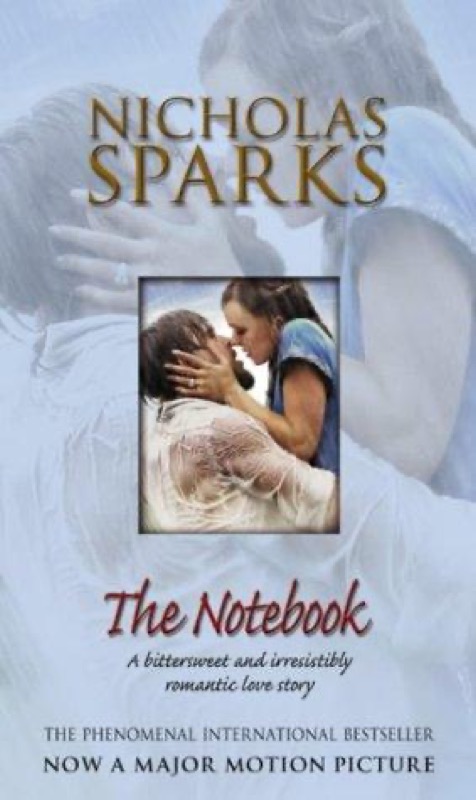
The Notebook (The Notebook, #1)
An old man in a nursing home reads a notebook to a woman who no longer knows him — Sparks’s first novel, and still the template every love story gets measured against.
Hook & thesis
The Notebook’s frame is its argument. An elderly man reads the same story aloud, day after day, to a woman whose memory resets overnight — because on the good days, the story brings her back. Inside the frame: the summer of 1940, class doing its quiet violence, a year of letters intercepted by Allie’s parents — and Noah’s answer, a house restored over fourteen years, the letter he writes in lumber because the paper ones never arrived. The novel’s wager is that devotion is a practice, not a feeling: the reading aloud is the marriage, continued by other means. Verdict: Sparks’s best-built book, leaner than the empire it founded. Its cost is the sentimentality tax — the frame’s miracle moments ask more suspension than the summer story does — and a generation of imitators who copied the tax without the build.
The contextual pivot
The Notebook was published in 1996, Sparks’s first novel, written in about six months around a job selling pharmaceuticals and drawn — by his own account — from his wife’s grandparents, whose sixty-year marriage he witnessed at its frail end and thought, essentially: this is the story. The publishing history is industry legend: a young agent, Theresa Park, pulled it from the slush pile; a bidding war; a million-dollar advance for a first-time novelist; a year on the bestseller list. It founded an empire with a fixed geography and grammar — coastal Carolina, letters, houses, illness, weather as emotion — and the 2004 film fixed Noah and Allie in the culture’s permanent cast, making the book less a novel than a standard against which a genre measures its sincerity. What gets forgotten inside the franchise is how lean the first instance is: a short novel, a frame tale, and an old man’s voice doing all the work.
Deep-dive critique
The narration runs on two rails: a first-person frame — the old man in the nursing home, who names himself only at the end — and the summer story he reads aloud, told in third person. The frame is the book’s real craft: Sparks rations its information, letting the reader assemble who the listener is and why the story works on her, and the reading-aloud device converts exposition into devotion — every chapter is an act of care before it is a piece of plot. The 1946 story itself is simpler machinery: class opposition, intercepted letters, a house restored as a fourteen-year letter written in lumber. The prose is plain to the edge of flatness in the summer sections, and that plainness is the strategy — the frame’s aged voice, plainspoken and unsparing about his own failing body, earns the sentiment the younger story merely requests. The flaws are the brand’s: dialogue that announces feelings rather than discovering them; Lon, the fiancé, written so blameless that Allie’s choice costs her nothing the book will make her pay; and an ending that spends in one scene more miracle than the novel’s careful accounting saved. But the accounting is the achievement. An empire of imitators copied the Carolina grammar and skipped the discipline: this first version is a frame tale about reading as a form of staying.
Discussion launchpad
Everyone quotes this book as a feeling. It’s built like a discipline: same story, same chair, every day, against a disease that erases the audience nightly.
Questions for the room:
- The frame claims the reading briefly brings Allie back, against medical sense. Miracle, metaphor, or the one lie the book asks as its price of entry?
- Allie’s parents intercept the letters; Noah builds a house instead. Two kinds of message — which does the novel trust?
- Lon is safe, approved, and genuinely kind. Is Allie’s choice a triumph of feeling, or the scales rigged — what does Lon actually do wrong?
- The ending, reported almost like a news item inside the fiction: beautiful, or the sentimentality tax coming due?
- The empire copied the template — Carolina coast, letters, illness, a house. What did the imitators keep, and what did they lose from this first, leanest version?