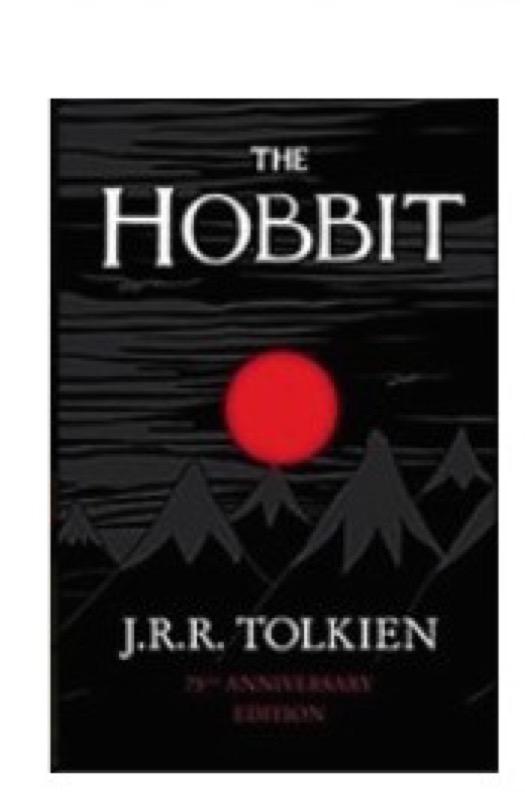
The Hobbit
A respectable hobbit who likes his kettle on and his adventures elsewhere is burgled by a wizard and thirteen dwarves — the children’s book that accidentally founded modern fantasy.
Hook & thesis
The Hobbit begins as a bedtime story with its narrator leaning into the room — In a hole in the ground there lived a hobbit — and the voice never leaves: avuncular, interrupting, warning you what’s coming. Bilbo’s arc became the template a thousand quest heroes inherited, but Tolkien’s version is more honest than its descendants: his great moments aren’t battles — he’s asleep or invisible for much of the Battle of Five Armies — but acts of mercy and nerve. Sparing Gollum. Sneaking the Arkenstone to the enemy camp as a bargaining chip, the one genuinely adult decision in the book, made by its smallest person. And underneath the children’s story the older world keeps pressing through the nursery walls: songs about wars, swords with histories, a necromancer offstage. Verdict: The most influential children’s book of its century and still the warmest door into Tolkien. Its cost is the dwarves — thirteen names in search of personalities — and a war it hurries through at the end. Though Bilbo would say that’s rather the point.
The contextual pivot
The Hobbit began, by Tolkien’s own telling, on a blank page of an exam script he was marking — ‘In a hole in the ground there lived a hobbit’ — written around 1930 by an Oxford professor of Anglo-Saxon who had been building languages and legends since the trenches. It was published in 1937 by Allen & Unwin, whose chairman’s ten-year-old son, Rayner Unwin, famously recommended it in a reader’s report that earned him a shilling. The children’s book it appears to be is a door into the legendarium Tolkien thought no one would ever publish: the Silmarillion material presses through the nursery walls in songs, swords with Gondolin pedigrees, and a Necromancer in Dol Guldur who exists because the larger mythology needed him offstage. Its success demanded a sequel, and the sequel changed the world — but the 1951 revision of the Gollum chapter, retrofitted so the Ring’s nature matched The Lord of the Rings, is the hinge on which children’s story and epic visibly separate: two versions of one scene, marking the exact spot where Tolkien’s imagination darkened.
Deep-dive critique
The narration is third person but nothing like limited: Tolkien’s narrator is omniscient, intrusive, and unembarrassed — he addresses the reader directly, apologizes for Bilbo, withholds and foreshadows (‘as we shall see’), and knows the whole map of Middle-earth beyond the story’s edge. The effect is a bedtime-story contract: an adult voice mediating a frightening world for a listener it keeps checking on, which is why the book’s scares — trolls, Gollum, Mirkwood’s spiders — land at exactly child-manageable voltage. The prose runs on songs and set pieces, episodic by design: a picaresque of thresholds, each chapter a door into a new host, captor, or riddle. The flaws are the known ones: thirteen dwarves differentiated mostly by hood color and one fat joke carried to the end; female characters essentially absent from the world; and a climax — the Battle of Five Armies — that the narrator rushes and Bilbo sleeps through, whether from a children’s author’s mercy or a combat veteran’s refusal to make war a spectacle for children. The 1937 Gollum, who loses the riddle game fairly and offers to show Bilbo the way out, remains the book’s most haunting survival: proof, preserved in first editions, that the story was once kinder than the world it grew into.
Discussion launchpad
Took against Baggins, door against road: the book’s argument is about what a comfortable life owes the uncomfortable world.
Questions for the room:
- Bilbo’s finest act is a betrayal — handing the Arkenstone to Thorin’s enemies. Heroism, treason, or the only grown-up move on the board?
- If more of us valued food and cheer and song above hoarded gold, it would be a merrier world. Thorin’s deathbed recantation — does the book believe it, or is it what dying men say?
- The narrator keeps stepping in to warn and tease. What does that voice do for a child reader — and what does it cost an adult one?
- Tolkien rewrote the Gollum chapter in 1951 to fit the darker sequel: in 1937 Gollum loses fairly and shows Bilbo out. Two versions of one scene — what changed in Tolkien’s imagination between them?
- This sat on your Grade 11 syllabus between Gatsby and The Color Purple. Why does it belong there — if it does?
#LitClass #Grade11 #RequiredReading #juvenile #fantasy