
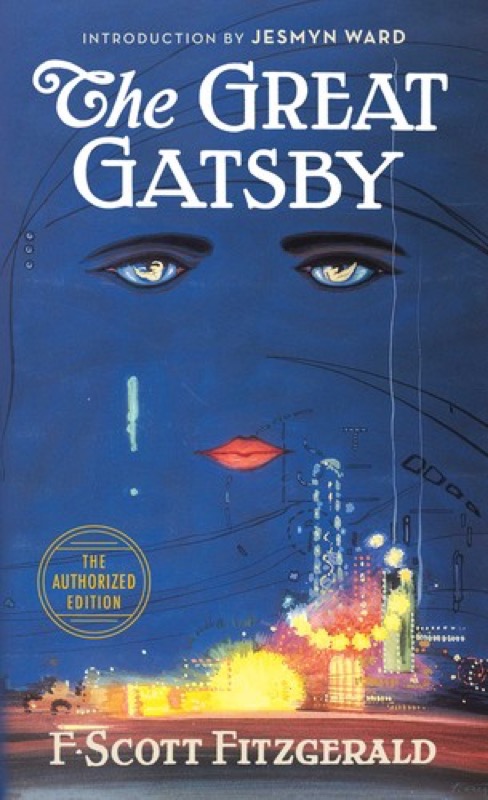
The Great Gatsby
A bootlegger throws parties for a whole city to impress one woman across the water — Fitzgerald’s perfect, poisonous little novel about wanting the past back at retail price.
Hook & thesis
Gatsby is a haunting narrated by a bystander. Nick Carraway takes the cottage next door, reserves judgment he doesn’t actually withhold, and assembles — out of parties, rumors, and one long confession over tea — the shape of a man who built a mansion and a criminal fortune as a delivery mechanism for a single moment: Louisville, 1917, before the war, when Daisy Fay’s voice was “full of money” and Jay Gatz’s self-invention was still brand new. Can’t repeat the past? Why of course you can! is the novel’s most honest and most damned sentence. Against it stands Nick’s final verdict on the Buchanans — careless people who smash things and retreat into their money and let others clean up. Verdict: The best-constructed American novel of its century, sentence for sentence. Its cost is Daisy, given a voice full of money and almost no interiority — the book’s subject and its blind spot in one person.
The contextual pivot
The Great Gatsby was published in April 1925 and was, by Fitzgerald’s own ledger, a disappointment — decent reviews, modest sales, nothing like the success of This Side of Paradise five years earlier. When he died in 1940, he believed it had been forgotten. Its resurrection is the famous accident of its afterlife: the Armed Services Edition, some 155,000 copies handed to soldiers in the Second World War, seeded a generation of readers, and the postwar academy did the rest — installing it as the Great American Novel and the default high-school text on the Dream. The Jazz Age romp its first readers took it for is still visible inside the canonical one: a book about bootleggers and parties, written by a man who was both, watching his own set with a participant’s knowledge and a hangover’s clarity. The copyright expired in 2021, and the sequels, prequels, and retellings have flooded in since — the culture now treating Gatsby the way Gatsby treated Daisy: as a past it insists on repeating.
Deep-dive critique
The narration is first person, Nick’s — but Nick is a novelist inside the novel, writing two years later, arranging his material, and Fitzgerald exploits the double position ruthlessly: Nick is ‘within and without,’ participant and prosecutor, and his famous reserve of judgment is a style rather than a fact, since no narrator in American fiction judges more continuously. The prose is the book’s true event: sentences of such finish that the plot — thin, melodramatic, borrowed from the crime papers — is carried by rhythm the way the parties are carried by music. The construction is symphonic rather than linear: scenes recur with variation (two parties, two lunches, two drives across the ash heaps), images accrue — the green light, the eyes of Eckleburg, the valley of ashes as the book’s true center — and the Plaza confrontation is staged as the hinge everything before it was tuning. The flaws are the standing ones: Daisy is a voice and a symbol, granted no scene of solitary thought in the book that bears her gravity; Myrtle and Wilson are class instruments more than people; and the ending’s machinery — a mistaken car, a pool, a revolver — is pulp plotting that the prose has to lift, and mostly does. What no flaw touches is the compression: under fifty thousand words, and a whole civilization’s self-image fits inside it, with room left over for the boats against the current.
Discussion launchpad
The syllabus calls it the American Dream novel. The book itself is more specific and less kind: a machine for sorting dreams by the age of the money behind them.
Questions for the room:
- Is Gatsby’s project romantic, delusional — or the most American sentence in the book?
- Nick calls himself one of the few honest people he’s known, and narrates a book full of his own omissions. What is he protecting — Gatsby, or himself?
- Daisy: subject, or blind spot?
- Tom and Daisy retreat into their money and let others clean up the mess. A century on, is the carelessness the most contemporary thing in the novel?
- The green light gets assigned to every schoolchild in America. What did you find in this book at Grade 11 that the syllabus didn’t mention?
#LitClass #Grade11 #RequiredReading #Classic #AmericanLiterature