
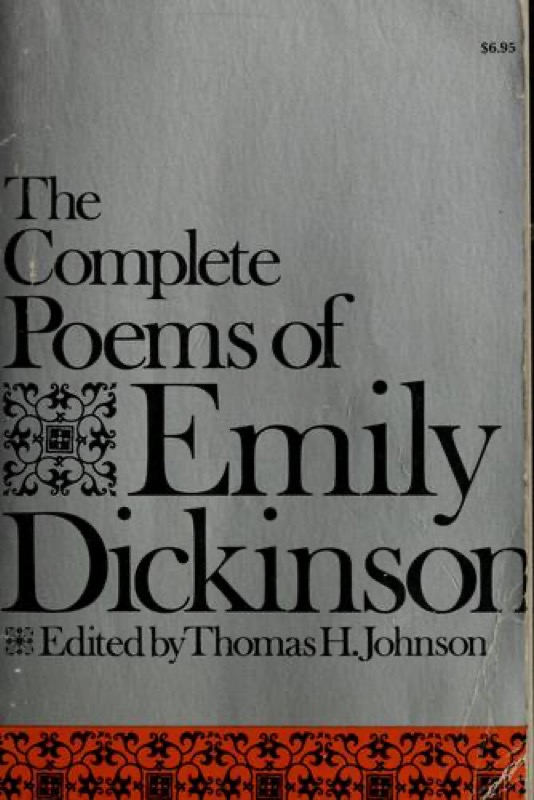
The Complete Poems of Emily Dickinson
Hook & thesis
Emily Dickinson’s The Complete Poems stands as a testament to the complex dance between desire and despair, where the heart’s yearning mirrors the eternal shadow of mortality. Verdict: Dickinson’s work transcends mere poetry; it is a haunting exploration of the human condition that leaves the reader ensnared in its web of longing and loss.
The contextual pivot
In the pantheon of gothic-horror-romance, Dickinson occupies a unique niche, straddling the line between the romantic and the macabre. Her poems reveal a world where beauty and death intertwine, evoking the same atmospheric intensity found in works by Edgar Allan Poe and the Brontë sisters. Yet, while those authors might rely on narrative structure, Dickinson’s genius lies in her compact, enigmatic verses that invite readers to ponder the depths of existence. The invisible audience here is one that appreciates the interplay of emotion and intellect; Dickinson’s exploration of desire and mortality bridges niche themes with universal resonance, inviting both the seasoned scholar and the casual reader into her darkly romantic realm.
Deep-dive critique
Structurally, Dickinson’s poems often employ slant rhyme and unconventional punctuation to create a disjointed rhythm that mirrors the tumult of the human psyche. For instance, her use of dashes disrupts the expected flow, compelling readers to pause and reflect, enhancing the emotional weight of her themes. The thematic success of her work lies in its ability to encapsulate profound truths in brief, powerful bursts—think of “Because I could not stop for Death” as a meditation on the inevitability of mortality, where the carriage ride symbolizes the journey toward the unknown.
However, the brevity of her verses may also alienate those who seek traditional storytelling, leaving some readers yearning for more context or narrative clarity. Yet, this very ambiguity is a strength; it forces readers to grapple with their interpretations and emotions, making each reading a personal experience. Dickinson’s characters—often faceless or abstract—embody universal desires and fears, reinforcing her work’s gothic elements as they navigate love, loss, and the ever-looming specter of death. The ending of her poems, often unresolved, is not a flaw but rather an invitation to linger in the uncertainty, a reflection of life’s inherent unpredictability.
Discussion launchpad
Dickinson’s poetry prompts profound reflection, yet it also invites divisive opinions on its accessibility and emotional impact.
- How does Dickinson’s use of unconventional structure enhance or hinder the reader’s connection to her themes?
- Does her ambiguity invite deeper engagement, or does it frustrate readers seeking clarity?
- In what ways do her explorations of death and desire resonate with contemporary audiences compared to her original readership?
- Are Dickinson’s themes of isolation and longing universally relatable, or do they risk alienating those unfamiliar with her style?
Questions for the room:
- How do you interpret Dickinson’s portrayal of death in relation to desire?
- What are your thoughts on her use of punctuation and form? Does it serve the content effectively?
- In what ways do you see her work influencing modern poetry?
- How do you reconcile the seemingly bleak outlook presented in her poems with the beauty of her language?
#TheOrchidRoom #gothic #poetry #romanticism #literaryanalysis