
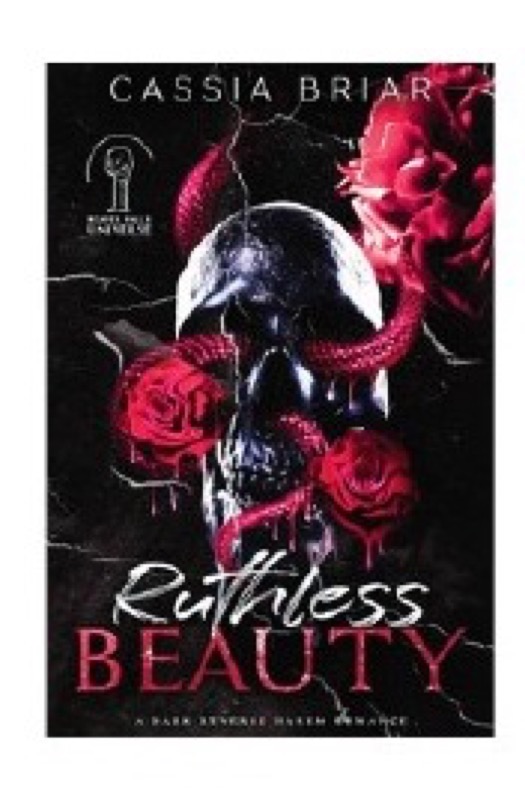
Ruthless Beauty
A Dark Reverse Harem Romance
Hook & thesis
In Ruthless Beauty, Cassia Briar plunges readers into a seductive abyss, where love and violence entwine with fatalistic allure. Verdict: This novel masterfully unveils the paradox of desire — that beauty often harbors a ruthless edge.
The contextual pivot
Ruthless Beauty occupies a distinct niche within the reverse-harem genre, a subcategory that often flirts with tropes of possession and rivalry. Briar’s narrative navigates these waters with a blend of gothic romance and dark fantasy, echoing the sensibilities of authors like Sarah J. Maas and Jennifer L. Armentrout, yet she carves out her own territory by weaving in deeper explorations of mortality and existential dread. The invisible audience likely comprises readers drawn to darker themes of love and power dynamics but who also seek a profound emotional resonance beyond mere titillation. Briar bridges the gap between niche genre enthusiasts and general readers through her compelling characterizations and the visceral stakes of her plot.
Deep-dive critique
The novel’s structure is notably non-linear, oscillating between past and present, which mirrors the protagonist’s inner turmoil and creates a palpable tension that keeps readers on edge. Briar employs a close third-person perspective that allows for intimate access to the protagonist’s psyche, making her struggles with love, betrayal, and the inevitability of death feel immediate and visceral. The pacing, particularly in the latter half, accelerates as the stakes heighten, leading to a climax that revels in both catharsis and chaos.
Character development shines in the nuanced portrayals of the harem members, each serving as a reflection of the protagonist’s desires and fears. The dialogue crackles with tension, encapsulating the intricate power plays at work. However, the prose occasionally flirts with melodrama, risking immersion at moments where emotional beats could benefit from more restraint. The thematic exploration of beauty intertwined with danger is compelling, yet at times, it feels like the narrative leans too heavily on familiar tropes without fully subverting them, leaving a lingering sense of predictability.
The ending, while satisfying in its resolution of several arcs, raises questions about the permanence of the connections forged. It invites readers to ponder whether true love can exist in a world where beauty is both a weapon and a curse.
Discussion launchpad
Ruthless Beauty presents polarities that invite fervent debate among readers, particularly around themes of love, power, and moral ambiguity. The seductive yet dangerous portrayal of relationships may provoke differing interpretations of agency and consent.
Questions for the room:
- How does Briar’s portrayal of the reverse-harem dynamic challenge traditional power structures in romance?
- In what ways does the non-linear structure enhance or detract from the emotional impact of the narrative?
- Do you think the novel’s exploration of beauty and violence offers a new perspective or simply recycles existing tropes?
- How do the character arcs reflect the broader themes of mortality and desire?
- Is the ending a celebration of love’s triumph or a cautionary tale about the consequences of desire?
#TheOrchidRoom #RuthlessBeauty #darkromance #reverseharem #literaryanalysis