
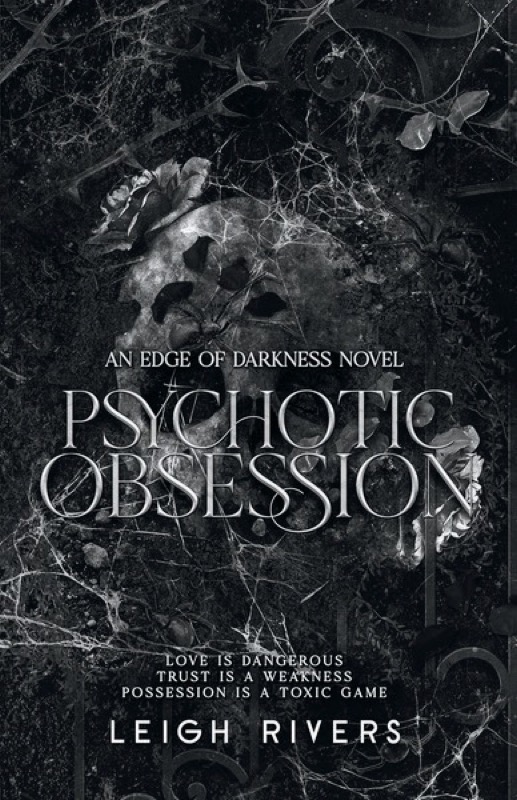
Psychotic Obsession
An Edge of Darkness Novel
Hook & thesis
In Psychotic Obsession, Leigh Rivers deftly navigates the murky waters of desire and the human psyche, revealing how obsession can masquerade as love while ensnaring its victims in a web of manipulation. Verdict: This gripping exploration of psychological entanglement serves as a cautionary tale about the thin line between passion and peril.
The contextual pivot
Positioned within the stalker-obsession subgenre, Rivers’ work resonates with echoes of Patricia Highsmith’s Ripley series and even the brooding tone of Daphne du Maurier’s Rebecca. This book not only caters to an audience that craves suspenseful dark romance but also bridges a gap for general readers who appreciate psychological complexity. Rivers’ ability to weave gothic elements—think shadowy corridors and ominous silences—invites readers into a world where emotional landscapes are as treacherous as physical ones.
Deep-dive critique
Rivers employs an intricate structure that unravels the protagonist’s psyche through a dual narrative, allowing readers to oscillate between victim and captor. This choice amplifies tension, effectively immersing us in the protagonist’s descent into obsession. Pacing fluctuates, with moments of breathless urgency juxtaposed against sinister lulls that leave the reader in a state of heightened anxiety. The dialogue crackles with a sense of dread; Rivers masterfully uses subtext to unveil the psychological manipulation at play, crafting exchanges that are as chilling as they are revealing.
Characterization is robust, especially in the portrayal of the antagonist—whose charm veils a sinister intent. This complexity invites a deeper analysis of toxic relationships, compelling readers to reflect on the allure of danger entwined with love. However, moments of melodrama occasionally threaten to undermine the authenticity of the emotional stakes, suggesting that while the narrative flirts with its gothic roots, it occasionally leans too heavily into genre clichés.
The ending, while shocking, feels both earned and troubling, leaving us at the precipice of unresolved tension—an acknowledgment that not all obsessions lead to resolution or redemption. Rivers’ use of death imagery throughout enhances the stakes, serving as a constant reminder of the fragility of life when ensnared in such dark entanglements.
Discussion launchpad
This novel raises polarizing questions about the nature of obsession and the ethical boundaries of love. While some readers may feel a thrill in the exploration of dark themes, others may find the romanticization of toxic relationships troubling.
Questions for the room:
- Does the portrayal of obsession in the novel serve as a cautionary tale or inadvertently glamorize toxic relationships?
- How does Rivers’ dual narrative structure impact our empathy for the characters?
- In what ways does the gothic atmosphere enhance or detract from the psychological tension?
- Can we separate the allure of the characters from the moral implications of their actions?
- What unresolved themes resonate with you beyond the pages of this novel?
#TheOrchidRoom #PsychoticObsession #DarkRomance #LiteraryAnalysis #Gothic