
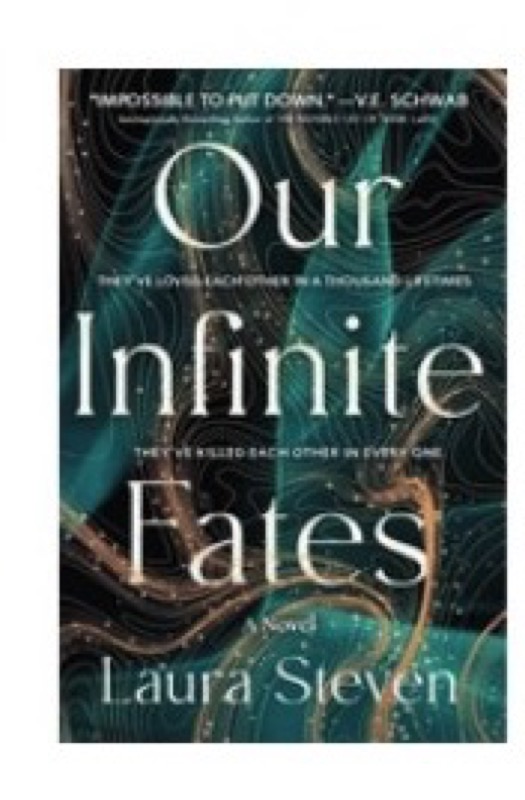
Our Infinite Fates
They've loved each other in a thousand lifetimes. They've killed each other in every one.
Hook & thesis
In Our Infinite Fates, Laura Steven expertly intertwines the threads of reincarnation and the enemies-to-lovers trope, exploring the haunting cycle of love and violence that binds two star-crossed souls across lifetimes. Verdict: This novel masterfully evokes the tension of inevitable tragedy while illuminating the complexities of desire and obsession, capturing the reader’s imagination in a way that is both enchanting and unsettling.
The contextual pivot
Situated within the dark romance genre, Our Infinite Fates builds a narrative that straddles the line between fantasy and contemporary fiction. Steven’s exploration of reincarnation is reminiscent of other works in the genre, like The Time Traveler’s Wife by Audrey Niffenegger, where love transcends time but is not without its pains. However, while Niffenegger’s approach is more lyrical and wistful, Steven leans into the darker aspects of obsession and violence, positioning her work firmly within the realm of romantasy. This places her alongside authors like Sarah J. Maas, whose characters often navigate complex relationships filled with tension and longing. The invisible audience here is likely those who appreciate a fusion of high stakes and emotional depth, making the book accessible yet rich enough to satisfy genre aficionados.
Deep-dive critique
The structure of Our Infinite Fates fluidly oscillates between different timelines, each revealing layers of the protagonists’ tumultuous relationship. This pacing invites the reader to grapple with the gravity of their shared fates, making every moment of connection feel poignant and charged. Steven employs a third-person limited perspective that allows for intimate insights into the characters’ psyches, particularly the conflict between their deep-seated love and the violent histories that entangle them.
Yet, while the prose shines with lyrical beauty, certain dialogue moments verge on melodrama, occasionally detracting from the otherwise immersive world-building. The characters, while well-defined, sometimes fall into familiar archetypes, which could dilute the impact of their unique predicament. However, the thematic success lies in the exploration of obsession and how it can both ignite passion and lead to ruin, a duality that resonates throughout the narrative. The ending, while offering resolution, leaves several threads tantalizingly unresolved, inviting reflection on the nature of fate and free will.
Discussion launchpad
The interplay of love and violence presents a rich ground for debate. Readers may find themselves grappling with the ethical implications of obsession depicted in the narrative, as well as the cyclical nature of the protagonists’ relationship.
- Questions for the room:
- How does Steven’s portrayal of obsession challenge or reinforce romantic ideals?
- Can love truly exist without the specter of violence, as depicted in the book?
- What are your thoughts on the cyclical nature of reincarnation in romantic narratives? Does it enhance or detract from the emotional stakes?
- How do the characters’ identities shape their choices across lifetimes, and do they evolve or repeat?
- What unresolved questions linger after the conclusion, and how might they influence your interpretation of the story?
#TheOrchidRoom #enemiestolovers #darkromance #reincarnation #literaryanalysis