
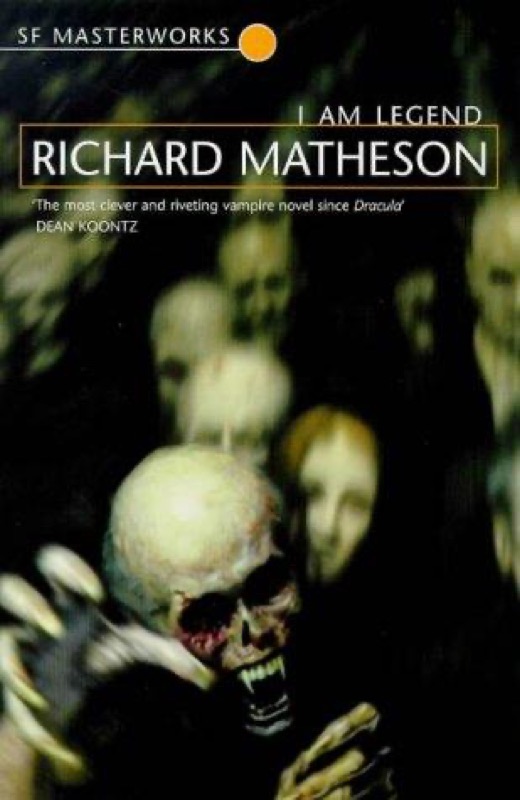
I Am Legend
Hook & thesis
Richard Matheson’s I Am Legend is a haunting exploration of isolation and humanity’s fragility in the face of overwhelming otherness. Verdict: This novel is a masterclass in existential dread, where the true horror lies not in monsters but in the solitary struggle for identity within a collapsing world.
The contextual pivot
Situated at the crossroads of gothic horror and speculative fiction, I Am Legend extends beyond a mere vampire narrative to interrogate the very essence of humanity. Matheson crafts a bleak landscape where the protagonist, Robert Neville, grapples with his sanity amidst a nightmarish epidemic transforming his neighbors into monstrous entities. This book resonates with themes found in the works of Shirley Jackson and H.P. Lovecraft, yet it uniquely bridges niche horror elements to a broader audience by exploring universal fears of loneliness and survival. Matheson’s work, published in 1954, also presciently reflects societal anxieties around disease and alienation, making it relevant for contemporary readers navigating a fractured world.
Deep-dive critique
Matheson’s structure is pivotal; the novel oscillates between moments of frenetic action and reflective solitude, mirroring Neville’s internal descent. The first-person perspective immerses readers in his psyche, making his gradual unraveling palpable and disquieting. Matheson’s prose is spare but charged, allowing tension to simmer without overt reliance on gore. For instance, the meticulous descriptions of Neville’s daily rituals not only build suspense but also serve as a stark contrast to the chaotic world outside his home, evoking a sense of claustrophobia and impending doom.
Characterization is another strength; Neville is simultaneously relatable and tragic, embodying the quintessential anti-hero. His interactions with the vampires, particularly as he begins to view them through a lens of empathy, deepen the thematic exploration of what it means to be ‘human.’ The ending, both abrupt and profound, invites readers to grapple with the implications of Neville’s legacy and the shifting definitions of monster and man. Yet, one might argue that the pacing falters in certain segments, where philosophical musings might overshadow narrative momentum, risking reader engagement.
Discussion launchpad
The interplay of horror and humanity in I Am Legend raises provocative questions about identity and morality. Matheson’s portrayal of Neville’s existential struggle can polarize readers: Is he a hero or a monster in his own right?
Questions for the room:
- How does Matheson’s depiction of isolation resonate with contemporary societal issues?
- In what ways does the novel challenge traditional vampire lore?
- Can Neville’s evolution be seen as a form of redemption, or is it a descent into madness?
- What role does the setting play in amplifying the themes of fear and survival?
- How does the novel’s ending alter our perception of Neville’s journey?
#TheOrchidRoom #gothic #horrorromance #vampires #darkheartlabs