
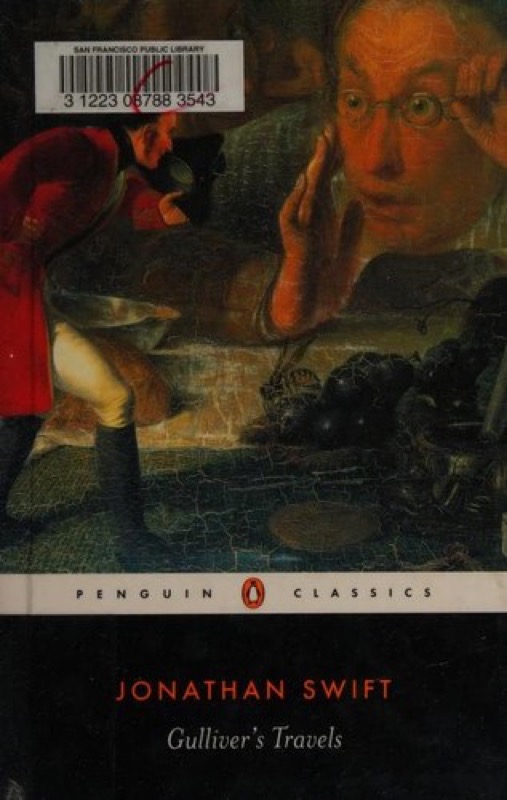
Gulliver’s Travels
Hook & thesis
Jonathan Swift’s “Gulliver’s Travels” serves as a scathing satire of human nature and society, revealing the absurdities of both through the lens of fantastical adventure. Verdict: This seminal work transcends mere fantasy, unearthing the darker elements of our civilization in a manner that is both incisive and unforgettable.
The contextual pivot
Positioned within the canon of satirical literature, “Gulliver’s Travels” finds its roots in the early 18th century’s exploration of human folly, paralleling works from the likes of Voltaire and Cervantes. Swift masterfully blends adventure with political commentary, appealing to an audience that balances both literary enthusiasts and casual readers curious about societal critique. The narrative dissects complex themes, allowing it to resonate with contemporary audiences while bridging the gap between niche satire and mainstream literature.
Deep-dive critique
The structure of “Gulliver’s Travels” unfolds through a series of voyages, each marked by a distinct setting that serves to critique various aspects of society—from the political machinations of the Lilliputians to the morally ambiguous Houyhnhnms. This episodic pacing allows Swift to maintain tension while exploring each society’s absurdities, though it occasionally disrupts the narrative flow with its shifting focus.
Swift’s prose is a marvel, characterized by its clarity and wit. His use of irony and hyperbole elevates the absurdities portrayed, particularly in the contrasting characteristics of the tiny Lilliputians and the rational horses. Dialogue is sharp and illuminating, revealing character motives and societal norms with precision. While the ending, with its disillusioned protagonist, could be perceived as abrupt, it is ultimately earned, reflecting the narrative’s continuous descent into cynicism.
However, the sheer density of Swift’s political commentary may alienate some readers, as the layers of satire require careful unpacking. This complexity can be both a strength and a flaw, as it may invite confusion rather than reflection in those less familiar with the context of his critiques.
Discussion launchpad
The tension between Swift’s satirical genius and the accessibility of his themes creates a fertile ground for debate. Questions for the room:
- How effectively does Swift balance humor with dark political commentary?
- In what ways does the episodic structure enhance or detract from the emotional depth of the narrative?
- Can we separate Swift’s personal biases from his broader critiques of society, or are they inextricably linked?
- Which of Gulliver’s experiences do you find most reflective of contemporary societal issues?
- Does the ending of the novel provide a hopeful resolution, or does it ultimately reinforce a sense of despair?
#LiteraryAnalysis #darkthriller #satire #politicalcommentary #theorchidroom