
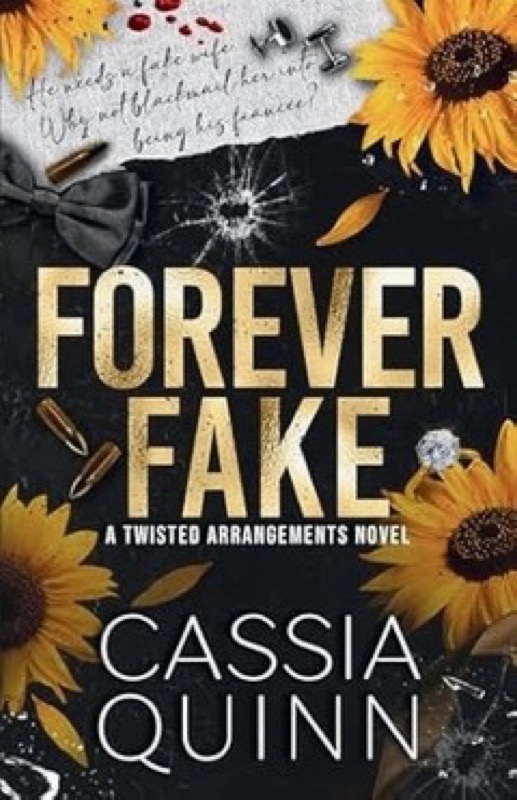
Forever Fake
He needs a fake wife. Why not blackmail her into being his fiancée?
Hook & thesis
In Forever Fake, Cassia Quinn intricately weaves a tale of desire and manipulation, exploring the depths of arranged marriages through a lens of coercion and conflict. Verdict: This narrative, while steeped in dark romance tropes, ultimately exposes the fragility of consent, making it a provocative commentary on power dynamics in relationships.
The contextual pivot
Positioned firmly within the arranged-marriage subgenre, Forever Fake sits alongside other contemporary dark romances that delve into themes of power and deception, reminiscent of authors like Anna Zaires and Talia Hibbert. Quinn’s story navigates the blurred lines between love and obligation, targeting readers who relish a juxtaposition of desire and danger. While it employs familiar tropes of fake relationships and blackmail, the book’s unsettling undertones challenge both the niche audience of dark romance enthusiasts and those curious about the moral complexities behind such arrangements.
Deep-dive critique
Quinn’s use of dual perspectives enriches the narrative, allowing readers to experience the psychological games played by both protagonists. This structure enhances the tension, as alternating viewpoints reveal their vulnerabilities and desires, creating an emotional depth that is both compelling and unsettling. The pacing, particularly in the early chapters, can feel deliberate, almost languorous; however, this mirrors the protagonists’ gradual acceptance of their circumstances and ignites a simmering tension that propels the plot forward.
The prose is sharp and evocative, capturing the raw intensity of the characters’ emotions without shying away from the darker elements of their relationship. Quinn’s dialogue crackles with wit and underlying menace, particularly in scenes where power dynamics shift, showcasing her skill in crafting conflict that feels both immediate and authentic. However, certain mechanical flaws emerge in the supporting characters, whose motivations sometimes feel underdeveloped or cliché, weakening the overall impact of the world-building.
The ending, while ostensibly satisfying, raises questions about the characters’ transformations and whether they truly reflect growth or simply a concession to their circumstances. This ambiguity invites reflection on the nature of agency and choice within the confines of such manipulative relationships.
Discussion launchpad
Forever Fake poses complex ethical questions that may polarize readers. While many may revel in the tension of the protagonists’ arrangement, others may find the coercive elements troubling, potentially detracting from the romantic aspects of the narrative.
Questions for the room:
- How do you interpret the balance of power in the relationship — does it empower or undermine genuine connection?
- Can a relationship based on coercion ever evolve into something healthy, or is the premise fundamentally flawed?
- In what ways does the narrative challenge or reinforce societal views on arranged marriages?
- How do the characters’ motivations reflect or distort our understanding of love and desire?
- Does the ending offer true redemption for the characters, or does it reinforce the cycle of manipulation?
#TheOrchidRoom #ForeverFake #darkromance #arrangedmarriage #literaryanalysis