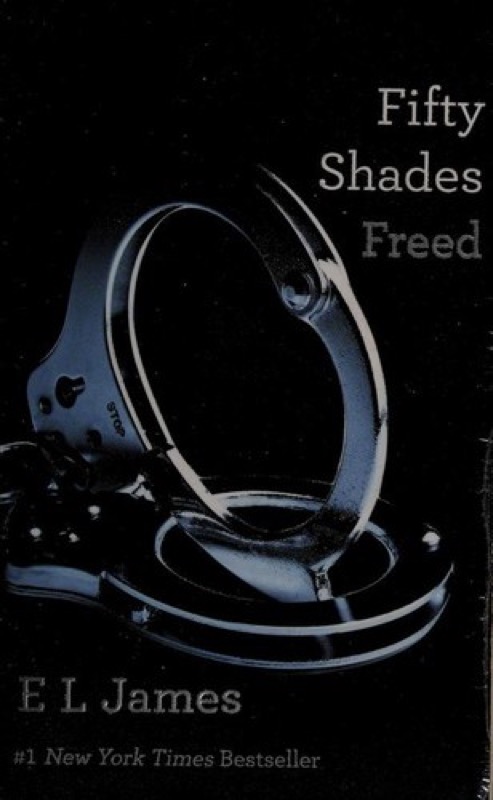
Fifty Shades Freed (Fifty Shades, #3)
Married, honeymooned, and immediately at war over what marriage is allowed to change — while Jack Hyde’s grudge turns the finale into a rescue plot.
Hook & thesis
Freed runs two books in parallel and dares them to collide: a marriage negotiating its domestic terms — her job, her name, his surveillance dressed as security — and a thriller in which Ana’s former boss graduates from blackmail to kidnapping. The surprise is which plot carries the emotion. The kidnapping resolves in an afternoon; the unplanned pregnancy detonates the marriage for a hundred pages, because it’s the one term neither of them negotiated. Verdict: The fullest of the three as a relationship novel and the least disciplined as a thriller; its cost is proportion — the guns keep interrupting the argument the book is actually good at.
The contextual pivot
Fifty Shades Freed was published in January 2012 — the third volume inside nine months — and landed at the moment the trilogy crossed from cult phenomenon to cultural argument: book clubs and bishops, sales records and a backlash literature of its own. Freed is where the trilogy’s destination becomes clear: it was always a marriage plot. The Gothic trappings of the first book — the contract, the Red Room, the billionaire as Byronic monster — resolve here into the oldest shape in the English novel, the reformed rake settled into domesticity, with the thriller machinery (Hyde’s revenge, a kidnapping) imported to keep a wedding-and-household story at thriller temperature. The retellings that followed, from Christian’s side, confirmed what this volume already knew: the franchise’s engine was never the equipment. It was the negotiation — and marriage is negotiation with the exits closed.
Deep-dive critique
The narration stays in Ana’s first person, but the structure loosens: flashbacks braid the honeymoon into the marriage’s first crisis, so the book opens inside a bliss it has already told us is temporary. The craft problem of the trilogy peaks here — with the contract gone and the couple married, James must generate conflict from domestic terms: a job kept, a name hyphenated, a security detail refused. Those scenes, unglamorous and specific, are the best writing in the three books — power negotiated over email subject lines and dinner seating. The thriller plot is the opposite: Hyde’s escalation from blackmailer to kidnapper is mechanically competent and emotionally inert, and Ana’s solo rescue, staged as her graduation, resolves by gunfire a question the quieter scenes had already answered better — whether she can act inside this marriage without permission. The pregnancy detonation is the volume’s honest core: the one unnegotiated term, arriving as biology, and Christian’s regression to book-one control is both ugly and consistent with the trilogy’s thesis — that damage doesn’t retire, it just changes management. The epilogue’s domestic idyll is the fantasy completing itself. Whether it reads as earned, or as the contract in a softer font, is the argument the whole trilogy was always going to end in.
Discussion launchpad
Freed from the contract, the rules, his past — or freed into marriage, security details, and a new set of terms? The trilogy’s last argument is over the meaning of its own title.
Questions for the room:
- Whose freedom is it, finally — and what is each of them freed from, itemized?
- Ana’s solo rescue of Mia: she disobeys every instruction and is right. Does the book know it’s her graduation scene?
- Christian’s reaction to the pregnancy is his ugliest since book one — and his most explicable. Does the novel earn his terror, and does Ana’s forgiveness arrive too fast?
- Marriage was supposed to settle the power question. What actually got settled, and what just changed costume?
- Across three books the fantasy on offer shifts: the contract, the renegotiation, the household. Which version were the trilogy’s millions of readers actually buying?