
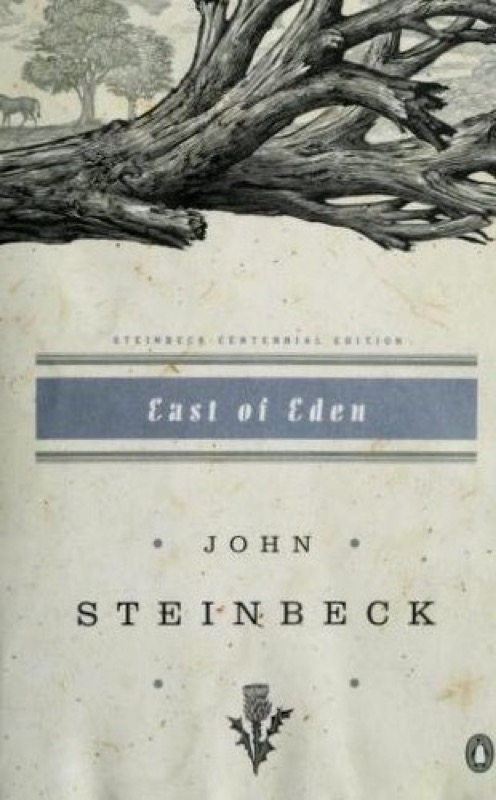
East of Eden
Hook & thesis
In John Steinbeck’s East of Eden, the author explores the enduring struggle between good and evil through the lens of two families in California’s Salinas Valley. The novel’s true engine lies in the moral conflicts that shape human nature and relationships. Verdict: Steinbeck’s intricate portrayal of these timeless themes renders East of Eden a profound exploration of humanity’s duality and the choices that define us.
The contextual pivot
East of Eden occupies a unique place within the American literary canon, often regarded as Steinbeck’s magnum opus. It traverses the boundaries of the family saga and moral philosophy, echoing the biblical stories of Cain and Abel while reflecting the broader themes of free will and redemption. In connecting the personal struggles of the Trask and Hamilton families with larger existential questions, Steinbeck bridges niche literary tropes to appeal to a more general audience seeking to understand the complexities of human nature.
Deep-dive critique
The novel’s structure is non-linear, with alternating timelines that enhance the thematic depth while exploring the generational conflicts between families. Steinbeck’s use of third-person omniscient narration allows for a multifaceted understanding of characters, particularly the contrasting figures of Charles and Adam Trask. The prose is rich and evocative, filled with vivid imagery that brings the Salinas Valley to life, yet it can sometimes feel heavy-handed, potentially alienating readers. The dialogue serves to deepen character relationships, though at times it can be overly expository. The thematic success is evident in the character of Cal Trask, whose journey illustrates the struggle for acceptance and the quest for identity in a morally ambiguous world. The ending, though somewhat ambiguous, is ultimately earned as it encapsulates the essence of choice and consequence.
Discussion launchpad
While East of Eden offers a compelling exploration of moral conflict, it invites polarizing interpretations of its characters and themes.
Questions for the room:
- Is Steinbeck’s portrayal of good versus evil too simplistic or a necessary reflection of human nature?
- How do the generational conflicts in the Trask family mirror contemporary issues in family dynamics?
- Does the novel’s heavy reliance on biblical allegory enhance or detract from its narrative?
- How effectively do the settings contribute to the characters’ internal struggles?
- In what ways does East of Eden challenge the reader’s understanding of free will?
#LitClass #Grade11 #RequiredReading #darkthriller #family saga