
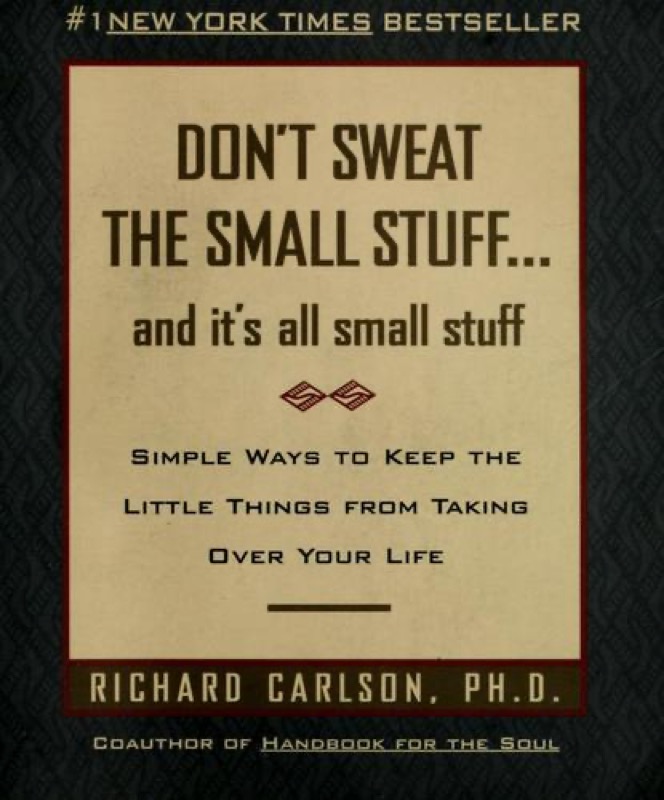
Don't Sweat the Small Stuff... and It's All Small Stuff: Simple Ways to Keep the Little Things from Taking Over Your Life
Hook & thesis
Richard Carlson’s Don’t Sweat the Small Stuff… and It’s All Small Stuff offers an intriguing exploration of how to navigate life’s myriad annoyances with grace. At its core, the book seeks to alleviate the burdens of modern existence by advocating for a mindset shift. Verdict: This self-help guide is a thoughtful yet simplistic treatise on mindfulness that, while well-intentioned, often glosses over the complexities of human emotion and resilience.
The contextual pivot
Positioned within the self-help genre, Carlson’s work emerges amidst a wave of literature that aims to provide practical coping strategies for an increasingly chaotic world. Unlike the darker undertones often found in psychological thrillers or romantic suspense, Carlson’s narrative is rooted in optimism and simplicity. The invisible audience here is likely comprised of individuals seeking relief from daily stressors, yet Carlson’s principles can bridge niche mindfulness concepts to a broader readership, offering universal accessibility.
Deep-dive critique
Carlson’s structure is straightforward, with each chapter acting as a standalone reflection on various life stressors. This pacing, while initially engaging, can lead to a sense of repetitiveness, as many themes circle back to the central tenet of not letting small issues dominate one’s life. The prose is conversational, making the text approachable; however, it lacks the literary depth that could elevate its message. For instance, when Carlson suggests that readers let go of resentment, the advice feels more platitudinous than transformative. Characterization is absent, as this work is devoid of characters or narrative arc—its strengths lie in its practical advice rather than storytelling.
The thematic success comes in its ability to resonate with readers who may feel overwhelmed; yet, the simplistic solutions presented often fail to engage with the underlying complexities of emotional struggles. The ending does not feel particularly earned, as it doesn’t offer a resolution or a new perspective, merely reiterating the book’s central message without further development.
Discussion launchpad
Carlson’s work raises essential questions about the nature of stress and emotional health—are we truly able to dismiss all small things, or do they accumulate into larger issues? This could polarize readers, particularly those who favor depth over simplicity in self-help literature.
Questions for the room:
- How do we balance the advice to dismiss small issues with the necessity of addressing deeper emotional pain?
- Can mindfulness truly be effective without acknowledging the complexities of modern life?
- Does Carlson’s approach risk oversimplifying serious mental health concerns?
- Is the book’s optimistic tone a strength or a weakness in conveying its message?
- How can we apply Carlson’s principles in a world increasingly filled with genuine stressors?
#LiteraryAnalysis
#selfhelp
#mindfulness
#stressmanagement
#TheOrchidRoom