
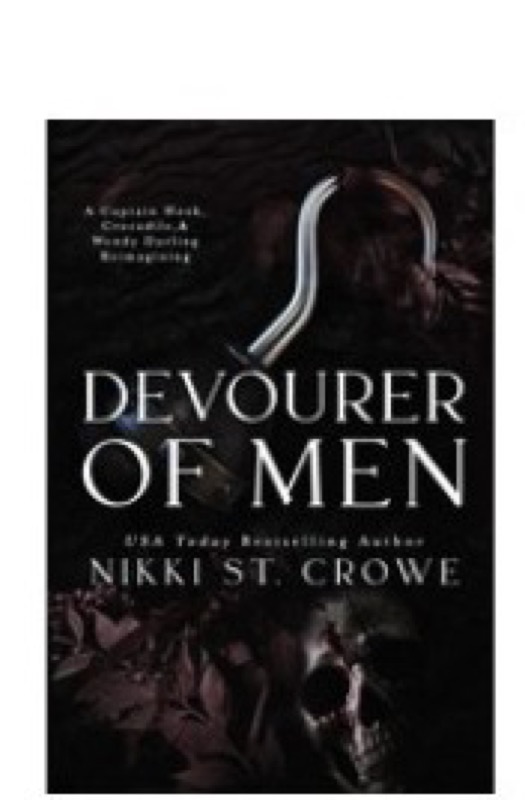
Devourer of Men
A Captain Hook, Crocodile, & Wendy Darling Reimagining
Hook & thesis
In Devourer of Men, Nikki St. Crowe reimagines the classic tale of Peter Pan through a darkly seductive lens, exploring the entangled fates of its characters against a backdrop of violence and desire. Verdict: This book masterfully intertwines the grotesque and the romantic, revealing how the deepest forms of longing can simultaneously uplift and consume.
The contextual pivot
Positioned within the fantasy-romance genre, Devourer of Men draws heavily from the archetypes present in classic fairy tales, particularly the darker elements found in Peter Pan. Crowe’s style resonates with those familiar with the gothic romance tradition, akin to authors like Sarah J. Maas or Holly Black, who often meld fantasy with intricate emotional landscapes. The invisible audience includes readers drawn to nuanced retellings that delve into the moral complexities of beloved characters, bridging niche tropes with broader themes of love and loss, making the story accessible without sacrificing its dark heart.
Deep-dive critique
Crowe employs a multi-POV structure, allowing readers to engage intimately with the motivations of characters like Hook and Wendy. The pacing is deliberate, with tension building steadily as the characters navigate their twisted relationships, reflecting their internal conflicts and the thematic undercurrents of desire and power. Crowe’s prose shines in moments of visceral imagery; descriptions of violence are laced with an intoxicating allure, heightening the contrast between beauty and horror. The dialogue is sharp, often echoing the characters’ inner turmoil, although some exchanges can feel overly expository, slightly undermining the otherwise immersive narrative.
Thematically, the book explores the consequences of obsession, with its characters representing various facets of longing. Hook embodies the duality of protector and predator, while Wendy grapples with her role as both muse and victim. However, the use of cannibalism as a motif can be polarizing, serving as both a literal and metaphorical device that challenges the reader’s comfort levels. The ending, while provocative, leaves some threads intentionally unresolved, inviting interpretations that may frustrate those seeking closure but enrich the text’s ambiguity and complexity.
Discussion launchpad
Devourer of Men is rife with elements that can ignite passionate debate among readers. The interplay of danger and desire, along with the gruesome themes, invites various interpretations of morality and agency.
Questions for the room:
- How does Crowe’s portrayal of Hook challenge or reinforce traditional villain archetypes?
- In what ways do the themes of cannibalism serve as a metaphor for emotional consumption?
- Do you find the ending satisfactory, or does it leave too much unresolved?
- How does the multi-POV structure affect your empathy toward the characters?
- Can we separate the romantic elements from the darker themes, or are they inextricably linked?
#TheOrchidRoom #fantasyromance #darkromance #literaryanalysis #devourerofmen