
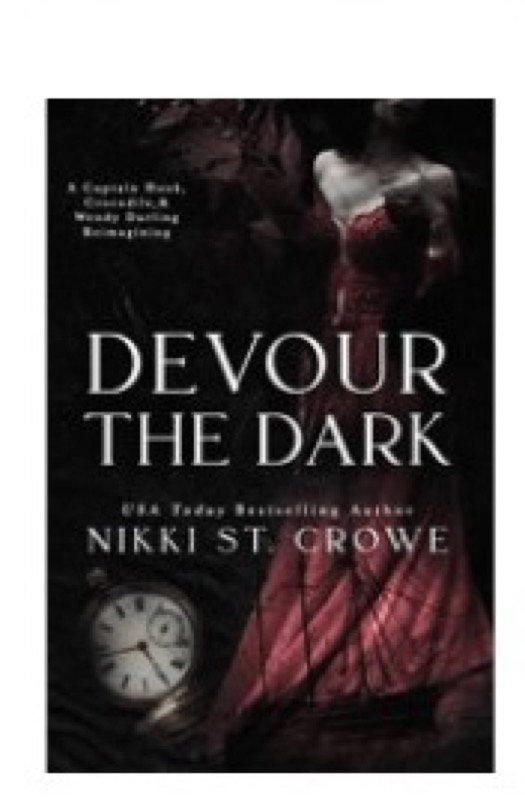
Devour the Dark
A Captain Hook, Crocodile, & Wendy Darling Reimagining
Hook & thesis
In Devour the Dark, Nikki St. Crowe reimagines the classic tale of Peter Pan through a lens of obsession and darkness, crafting a narrative that probes the depths of desire and the perils of unrequited love. Verdict: This book is a seductive labyrinth that entangles readers in its gothic embrace, revealing the haunting realities of longing and the cost of passion.
The contextual pivot
Positioned within the fantasy-romance genre, St. Crowe’s work melds the whimsical elements of Peter Pan with gothic undertones, creating a juxtaposition that both honors and subverts its source material. Unlike typical retellings that lean heavily on nostalgia, this version targets an audience comfortable with dark romance and morally complex characters. Readers familiar with authors like Sarah J. Maas or Jennifer L. Armentrout might resonate with St. Crowe’s ability to weave tension and desire, while those more inclined toward traditional fairy tales may find themselves unsettled by its raw intensity. The book bridges niche tropes into broader appeal without sacrificing the sharp edges that define its characters and themes.
Deep-dive critique
St. Crowe excels in her use of structure, employing a non-linear timeline that mirrors the chaotic and often tumultuous emotions of the characters. By shifting perspectives, she invites readers into the minds of Captain Hook, Crocodile, and Wendy, exposing the frailty of their desires and revealing how obsession can warp reality. Characterization is particularly compelling; Hook’s dark charm and Wendy’s internal conflicts make them both relatable and tragic figures, ensnared in a dance of power and vulnerability.
The prose is lush and evocative, with moments that capture the visceral experience of longing, yet it sometimes falters in pacing. Certain sections linger too long on exposition, risking reader engagement where swift movement would have heightened tension. Dialogue crackles with subtext, particularly in the exchanges between Hook and Wendy, where every word is laden with unspoken desire. However, some secondary characters lack depth, serving primarily as foils without their own arcs or complexities.
The ending, while satisfying in its resolution of emotional arcs, raises questions about the nature of love and sacrifice. It challenges the reader to confront the fine line between devotion and obsession, leaving a haunting resonance that lingers long after the final page.
Discussion launchpad
This novel offers a rich terrain for discussion, particularly regarding its exploration of obsession and the moral ambiguity of its characters. The gothic elements might provoke contrasting interpretations of love and desire, splitting opinions on the romanticization of toxicity.
Questions for the room:
- How do the darker elements of St. Crowe’s narrative reshape your understanding of the original Peter Pan story?
- Do you believe that obsession can ever be depicted positively in romance, or does it always lead to destructive outcomes?
- In what ways do you find the characterizations of Hook and Wendy resonate with contemporary discussions of relationships?
- How does the structure of the narrative enhance or detract from the themes of obsession and longing?
#TheOrchidRoom #fantasyromance #darkromance #peterpan #retelling