
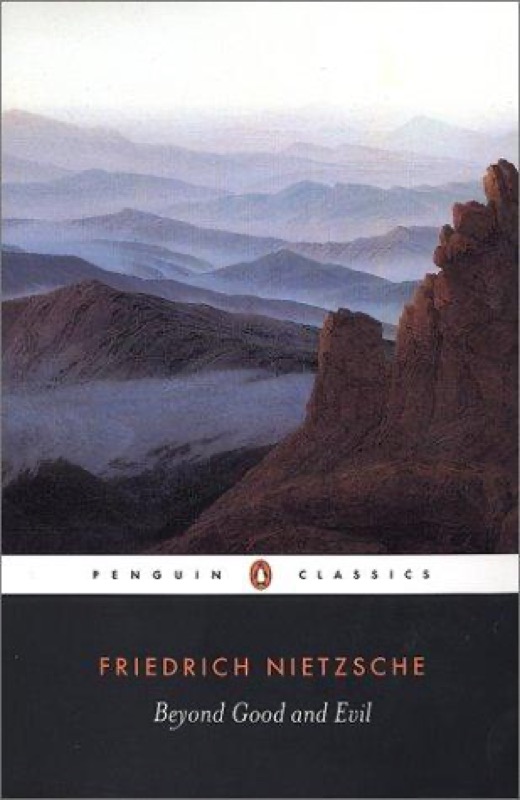
Beyond Good and Evil
Hook & thesis
Friedrich Nietzsche’s Beyond Good and Evil seeks to challenge the prevailing moral dichotomies of its time, positioning itself as an audacious call for intellectual freedom and the re-evaluation of values. Verdict: Nietzsche’s provocative exploration of morality is both a philosophical battle cry and an unsettling lens through which to examine contemporary ethical frameworks.
The contextual pivot
As a cornerstone of existential philosophy, Beyond Good and Evil transcends its genre of philosophical discourse, often resonating with the themes found in dark-thrillers that question moral absolutes. Nietzsche aligns himself with other existential thinkers, like Kierkegaard and Dostoevsky, while diverging through his unapologetic embrace of the will to power. The book primarily addresses an audience already familiar with philosophical inquiry, yet it bridges complex notions with accessible language, inviting general readers to engage with its themes of morality and human existence.
Deep-dive critique
Nietzsche’s structure is both deliberate and disjointed, employing aphorisms that reflect a fragmented yet layered approach to philosophical argumentation. The pacing is uneven; some sections burst forth with clarity and immediacy, while others meander through dense, abstract thought. This juxtaposition serves to both illuminate and obfuscate his core thesis regarding morality and truth.
The prose is razor-sharp, utilizing a blend of poetic rhythm and incisive wit that captivates while prompting deep reflection. For instance, Nietzsche’s use of metaphor—comparing the philosopher to a tightrope walker—effectively captures the precariousness of navigating moral landscapes. However, his penchant for grandiloquence may alienate readers seeking straightforward discourse.
While the philosophical conclusions drawn may feel unsatisfying or even nihilistic to some, the ending is earned through the cumulative weight of his arguments. Nietzsche does not provide comfort; instead, he challenges readers to confront the unsettling implications of his ideas, making the work a profound exploration of the human condition.
Discussion launchpad
Nietzsche’s work is bound to ignite lively debate, particularly regarding the nature of morality and the implications of his critique on truth. Questions for the room:
- Is Nietzsche’s rejection of absolute morality liberating or dangerous?
- How does his concept of the