
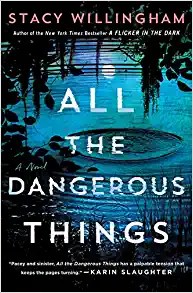
All the Dangerous Things
A year without sleep, a son taken from his crib — Isabelle Drake sells her grief to true-crime audiences to keep his case alive.
Hook & thesis
Isabelle Drake has not truly slept since the night Mason was taken — a year of microsleeps and gray gaps — and Willingham builds the novel inside that deprivation, where memory can’t be cross-examined because the witness was never fully awake. The true-crime circuit gives her a stage and a suspicion in the same breath: the mother who performs her grief too well, or not well enough. Verdict: The sleepwalking dread carries it; the podcaster thread occasionally says its ethics out loud when the scenes were already arguing them.
The contextual pivot
If Flicker asked what a killer’s child may become, the second novel asks what a victim’s mother may sell. Published in 2023, at the height of the true-crime boom, it turns the genre’s own machinery — conventions, podcasts, audiences hungry for a mother’s composure — into its subject. The Savannah marsh does the rest: a landscape that keeps what it takes, and gives it back changed.
Deep-dive critique
Insomnia is the narration, not a trait. Isabelle’s account has holes she knows about — nights she cannot reconstruct, a childhood history of sleepwalking she has spent a lifetime fearing — and the novel’s central terror is not the stranger at the crib but the possibility that the house’s own sleepwalker was awake enough to act. The sister’s drowning, decades back in the marsh behind the family home, is rationed out the way Flicker rationed 1999: one fact at a time, each recontextualizing the mother’s present guilt.
Waylon, the podcaster, is the industry’s friendly face — genuinely useful, genuinely feeding — and the book is honest about Isabelle needing him anyway.
The cost: the ex-husband’s thread runs thinner than the marriage’s wreckage warrants, and the final movement stacks its revelations close together. But the last turn lands where the book always pointed — at what a sleepless mind will confess to, true or not, to be allowed to rest.
Discussion launchpad
Isabelle performs her grief for strangers because strangers are the only search party left. This book makes its reader one of those strangers — and asks what we’re doing at the convention.
Questions for the room:
- Isabelle is suspected partly for performing grief wrong. What performance would have satisfied the circuit — and the novel’s reader?
- Does the book let true crime off the hook by making Waylon decent, or is that the sharper indictment?
- Sleepwalking is Isabelle’s lifelong fear of herself. How does the novel keep that dread fair rather than a cheat?
- The marsh gives back what it takes, changed. What does the setting know that the investigation doesn’t?
- Compare the mothers this genre usually gives us. What does Willingham refuse to do with Isabelle?