
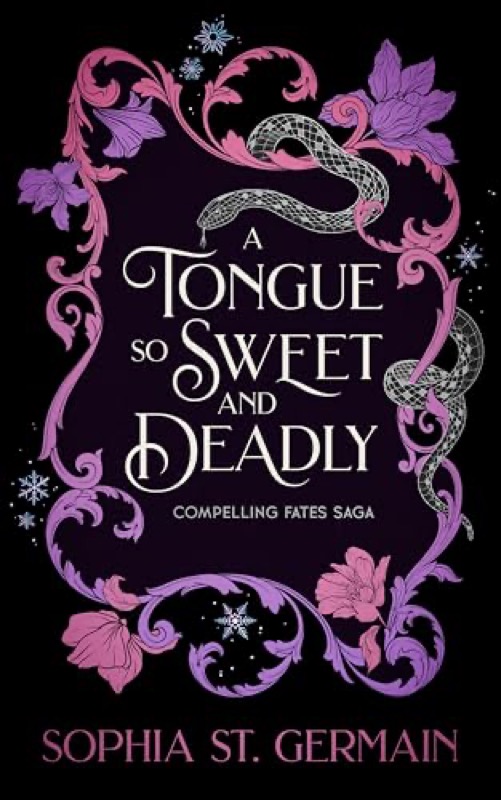
A Tongue so Sweet and Deadly (Compelling Fates Saga, #1)
Compelling Fates Saga, #1
Hook & thesis
In A Tongue so Sweet and Deadly, Sophia St. Germain crafts a haunting exploration of desire intertwined with mortality, revealing how love can become a double-edged sword. Verdict: This novel’s strength lies not in its supernatural elements, but in its piercing examination of how longing can corrupt and consume, making it a compelling addition to the gothic romance canon.
The contextual pivot
Positioned within the gothic-horror-romance genre, St. Germain’s work echoes the atmospheric tension of authors like Shirley Jackson and Daphne du Maurier, yet carves its own niche with a modern sensibility that resonates with contemporary readers. The novel deftly bridges the gap between niche tropes—such as the cursed lover and the haunted past—and a broader audience, inviting those typically drawn to romance to wade into darker waters. It serves as the inaugural entry in the Compelling Fates Saga, promising to expand on its themes of fate and desire across subsequent volumes.
Deep-dive critique
St. Germain’s narrative structure adeptly oscillates between past and present, facilitating a rich tapestry of character motivations that drive the story’s emotional stakes. The choice of a dual perspective, alternating between the tormented protagonist and the enigmatic love interest, invites readers into the intricate dance of their burgeoning obsession. For instance, the prose is imbued with rich, sensory detail that evokes a sense of foreboding, where even the mundane becomes laden with ominous potential—”the air hung thick with secrets, each breath a reminder of what lurked beneath the surface.”
However, the pacing occasionally falters, especially in the mid-section where the tension dissipates as the narrative meanders through exposition-heavy passages. This could alienate readers seeking the more fevered aspects of gothic romance. The dialogue, while often poetic, sometimes veers into the overly ornate, risking the authenticity of character voice. Still, St. Germain’s world-building excels, enveloping readers in a setting that feels both lush and claustrophobic, a perfect reflection of the characters’ inner turmoil. The ending, a masterclass in ambiguity, leaves readers both satisfied and unsettled, capturing the essence of the novel’s central conflict: the sweet yet deadly nature of love.
Discussion launchpad
The complexities woven into A Tongue so Sweet and Deadly prompt rich discussion about the interplay of love and death. Is love inherently destructive, or can it be a force for healing? The novel’s gothic elements also raise questions about the role of the supernatural in understanding human desires.
Questions for the room:
- How does St. Germain’s portrayal of desire challenge or reinforce traditional gothic tropes?
- In what ways do the supernatural elements serve the narrative’s exploration of human emotion?
- Does the ending provide a satisfying conclusion, or does it feel like an evasion of resolution?
- How does the dual perspective shape our understanding of the central conflict?
- Are the characters’ motivations relatable, or do they remain ensconced in the gothic archetype?
#TheOrchidRoom #gothic #horrorromance #literaryanalysis #darkheartlabs