
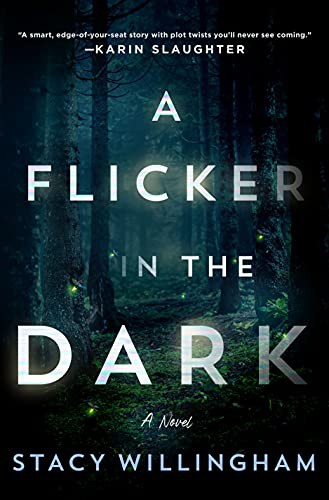
A Flicker in the Dark
Fireflies over dark water — a Baton Rouge psychologist whose father murdered six girls, watching the pattern start again.
Hook & thesis
Every small town keeps one house the children cross the street to avoid, and in Breaux Bridge it was Chloe Davis’s. Willingham writes the aftermath better than the crime: the father in prison, the mother gone quiet, the brother holding the family together with both hands, and Chloe building a careful Baton Rouge life that the twentieth anniversary takes apart in a single summer. Verdict: Atmosphere and family damage carry it; the procedural middle is the cost.
The contextual pivot
Willingham’s debut arrived in January 2022, into a thriller market a decade into the Flynn inheritance — wives, marriages, and narrators lying by omission. Flicker takes the era’s other raw material instead: true crime, and the families it leaves behind. Its question isn’t who the killer is. It’s what a killer’s child is permitted to become, and who gets to keep asking her about it. That the setting is Louisiana — Willingham’s own ground, written from inside its heat and its long memories rather than at them — is a large part of why the book outlasted its season.
Deep-dive critique
The structure is a rationing system. Chapters from the summer of 1999 alternate with the present-tense disappearances, and the childhood sections release exactly one new fact at a time — what Chloe saw, what she carried downstairs, what she has never told Cooper — so the past stays a live investigation instead of backstory. Chloe’s narration is the second mechanism: a psychologist’s vocabulary laid over a medicated, sleepless mind, forever diagnosing herself in the third person to avoid the first. The book plays fair more often than its genre requires; the clues are present before they’re legible, which is the difference between a twist and a trap.
Cooper is the quiet center — the brother who stayed, who manages Chloe’s information the way he manages everything, as care — and the novel is sharpest when it lets protection and control share a face.
The cost is real, and it’s the middle. Daniel, the fiancé, is drawn in outline where the family is drawn in depth, and Chloe’s access to the new investigation asks more credulity than the book elsewhere spends. But the ending reframes the expense: the question was never whether Chloe could find the pattern. It was what she would have to suspect about her own house to finish it.
Discussion launchpad
The discussion this book wants is about pattern-hunger. Chloe Davis survived childhood by learning to read her father’s house for danger, and the skill never switched off: twenty years later she reads Baton Rouge the same way, and the novel never certifies whether she’s detecting or grieving. It arranges, quietly, for the reader to do exactly what Chloe does — build a case out of flickers, and then wonder what we’ve actually proven.
Questions for the room:
- At what point did you stop fully trusting Chloe’s pattern — and which scene made you stop?
- Chloe reads other people’s minds for a living. Does the book treat her profession as her qualification, or her symptom?
- If the new disappearances had proved to be coincidence, would Chloe’s investigation still have been justified? Would the novel?
- Cooper protects Chloe by managing what she knows. Where does the book come down on protection as a form of control?
- The title points at fireflies — brief lights in dark. Where else does the novel work in glimpses, partial sight, things seen for a second and gone?